The system · Item 01
What is a GRC, and why does Singapore have these team seats?
A Group Representation Constituency is contested by a team of three to five candidates rather than one, at least one of whom must be from a minority community. Introduced in 1988. It is the reason a party has to field a full slate to contest most of the map.
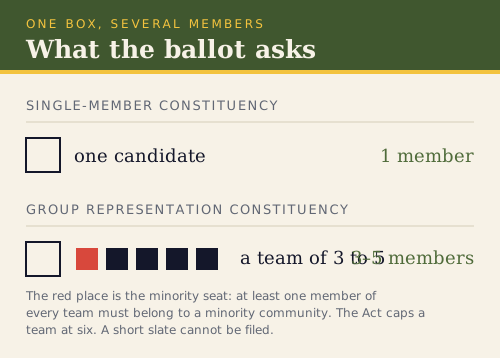
Most electoral systems ask a voter to choose between individuals. In a Group Representation Constituency, or GRC, the ballot lists teams. A voter marks one box and elects three, four or five Members of Parliament at once, all from the same party or the same independent slate. There is no way to split a vote across a team, and no way to elect four of a party’s five candidates while rejecting the fifth.
At least one member of every GRC team must belong to a minority community — Malay, Indian, or one of the other minority communities recognised for this purpose. That requirement is the stated reason the scheme exists.
Where the idea came from
The GRC was introduced by amendment to the Parliamentary Elections Act in 1988. The argument put forward at the time was demographic. Singapore elects its Parliament from a population that is predominantly Chinese, in single-member seats decided by simple plurality. A system like that offers no structural guarantee that minority candidates will be returned; it only offers the possibility. The government of the day argued that as the electorate grew younger and voting behaviour became less communal, that possibility would thin out, and that a guarantee was preferable to a trend.
The mechanism chosen was to bundle seats. If a team cannot be fielded without a minority candidate, and a voter cannot elect the team without electing that candidate, then minority representation stops depending on whether any individual minority candidate can win a seat on their own.
What a GRC changes in practice
Three consequences follow, and all three are argued over.
It raises the cost of contesting a seat. A single-member constituency requires one candidate, one deposit and one campaign. A five-member GRC requires five of each. For a large party with a deep bench that is an administrative matter. For a small party it is a threshold: a party that can find two credible candidates in a given area still cannot contest a five-member GRC, because it cannot field a full slate. Over several elections this has shaped which seats are contested at all and by whom, and it is the most common criticism levelled at the scheme.
It makes seats move in blocks. In a single-member constituency a swing of a few percentage points changes one seat. In a five-member GRC the same swing changes five. This cuts in both directions and has done so: the arrangement that protects a governing party’s margin in most contests also means that when a GRC does change hands, it changes hands wholesale. Aljunied GRC in 2011 is the clearest example — a single result moved five seats at once.
It attaches junior candidates to senior ones. Because a voter elects a team, a first-time candidate standing alongside a minister is elected on the same vote as the minister. Supporters of the scheme describe this as a way of introducing new members to the House. Critics describe it as a way of returning candidates who have not individually been tested at the ballot box. Both descriptions are of the same mechanism.
How large is a GRC
The size has not been fixed. The original amendment provided for teams of three. The permitted maximum rose over time to six, and the law was later changed to bring the average size down again. The Parliamentary Elections Act now sets the ceiling at six members and requires that at least one-quarter of all seats be single-member constituencies, so the map cannot consist of GRCs alone.
In practice the pattern since 2015 has been a shift toward smaller teams — more four-member GRCs, fewer five- and six-member ones — alongside an increase in the number of single-member seats. That shift is decided constituency by constituency, and by the body described in the next section.
Who decides which seats are GRCs
Not Parliament, in any direct sense, and not a standing independent commission. The boundaries and the composition of each constituency — whether a given area is a single seat, a four-member GRC or a five-member GRC — come from the Electoral Boundaries Review Committee, which is convened by the Prime Minister and reports to him. Its report is published, and in practice its recommendations have been adopted.
That is why the release of a boundaries report is read as the starting gun for an election, and why the report is examined for more than lines on a map. A ward that changes from a single seat to part of a GRC, or a GRC that grows from four members to five, has had the arithmetic of its contest altered before any candidate has been announced.
The minority requirement, precisely
The requirement is that a GRC team includes at least one candidate from a minority community. Which community is specified per constituency: some GRCs are designated as requiring a Malay-community candidate, others as requiring a candidate from the Indian or other minority communities. A candidate’s eligibility for that slot is certified by a committee before nomination, not asserted by the party.
Single-member constituencies carry no such requirement. Nothing prevents a minority candidate from standing in one, and minority candidates have been returned from single seats; the guarantee simply does not operate there.
What it does not do
A GRC does not guarantee a minority Member of Parliament in every part of the country, because not every constituency is a GRC. It does not guarantee any particular number of minority MPs beyond one per GRC team. And it does not address representation in Cabinet, in the civil service, or anywhere else — it is a rule about the composition of candidate slates, and nothing more.
It also does not say anything about who leads a team. A GRC slate has no formal captain; all its members are returned on the same vote and sit as equals once elected. In practice a senior figure anchors most slates, and the press treats that person as the team’s leader, but that is convention rather than law. When a GRC changes hands, every member of the losing slate loses the seat, including the anchor — which is what made Aljunied in 2011 unusual enough to be remembered by the name of the constituency rather than the names of the candidates.
How a GRC is contested
Nomination day makes the arithmetic visible. Every candidate on a slate files together, the deposits are lodged together, and the minority-community certification for the designated slot must already be in hand. A team that is one member short at the close of nominations does not contest a reduced version of the seat; it does not contest the seat at all.
That is why walkovers have been a recurring feature of Singapore elections rather than an oddity. A constituency goes uncontested when no opposing party can assemble a complete, certified slate before the deadline — not necessarily because no one wanted to stand there. Counting walkovers as a measure of political apathy reads the outcome without reading the mechanism that produced it.
Campaigning follows the same logic. Because the unit of election is the team, campaign material, rally appearances and the party’s own messaging are organised around the slate. A candidate cannot run a meaningfully separate campaign within a GRC, because there is no separate result to run for.
The turnover question
One effect is easy to state and hard to measure: how a member first enters the House.
A candidate elected in a single-member constituency has, by definition, won a contest under their own name. A candidate elected as the fifth member of a five-member GRC has been returned on a vote that was cast for the team. Both are Members of Parliament with identical powers, identical votes and identical standing in the chamber. The difference is only in what the result tells you about that individual’s support, and the answer in the second case is: nothing in particular.
This matters most at the point of succession. When an anchor figure retires from a GRC, the seat does not become vacant in the ordinary sense — the remaining members continue, and the party fields a replacement on the next slate. Parties on every side have used this to introduce candidates, and the criticism of the practice has been made from every side too, usually by whoever is not currently benefiting from it.
The by-election question
A further consequence surfaces when a member of a GRC team dies or resigns mid-term. The Constitution requires a by-election when a seat falls vacant, but the courts have held that a GRC seat vacated by a single member does not oblige the government to call one — the team continues to represent the constituency, minus one. If the vacating member held the minority-community slot, the position is argued more sharply, because the guarantee the scheme exists to provide is the thing that has lapsed.
The practical result is that a GRC vacancy is treated differently from a single-seat vacancy, and the timing of any by-election rests with the Prime Minister. This has been litigated and debated more than once, and the position has not changed.
Why it stays contested
The argument is rarely about whether minority representation is worth guaranteeing. It is about whether this is the instrument that guarantees it, or whether the guarantee is a by-product of an arrangement that has other effects — on the cost of entry, on the size of swings, and on how untested candidates enter the House.
Both sides of that argument have been made in Parliament repeatedly since 1988, and the scheme has been adjusted several times in response: the maximum team size has moved, the minimum number of single-member seats has been written into law, and average GRC size has come down. It has not been abolished, and no party contesting recent elections has campaigned on abolishing it outright.
Where to check this
The provisions are in the Parliamentary Elections Act, which sets out the requirement for a minority candidate, the permitted team sizes and the minimum number of single-member constituencies. The composition of each constituency for a given election is in the report of the Electoral Boundaries Review Committee published before that election. Debates on the original 1988 amendment and on each subsequent change are in Hansard, the official verbatim record of proceedings, published by the Parliament of Singapore.
FAQOn this page
How many members does a GRC return?
Between three and five on the ballot, with six the maximum the law allows. Every seat in the division is won or lost together.
Does the minority candidate have a different role once elected?
No. All members of the team are ordinary MPs with identical powers. The minority requirement applies at nomination, not afterwards.
Can a party contest a GRC with fewer candidates than seats?
No. An incomplete slate cannot be filed, which is why a small party with two strong candidates cannot enter a five-member division at all.
What share of seats must stay single-member?
At least a quarter of all elected seats. That floor is set by statute, not by convention.