Question Time · which-mps-have-asked-t
Parliamentary questions: Question Time, the supplementary, by ministry
Oral parliamentary questions get ninety minutes at the start of a sitting, and ministers have to stand up and answer them. Three and a half years of it, counted by member and by ministry, show a House where a handful of MPs do a disproportionate share of the asking — and three subjects that would not go away.
Published
— The count
| Measure | Value | Note |
|---|---|---|
| Oral questions in the period | 1,025 | answered on the floor |
| Ministries answering | 16 | |
| Questions from the busiest member | 62 | Leon Perera, NCMP |
| — of them to Trade and Industry | 12 | |
| Second busiest member | 57 | Er Dr Lee Bee Wah, Nee Soon GRC |
| — of them to Transport | 18 | |
| Third busiest member | 49 | Dennis Tan, NCMP |
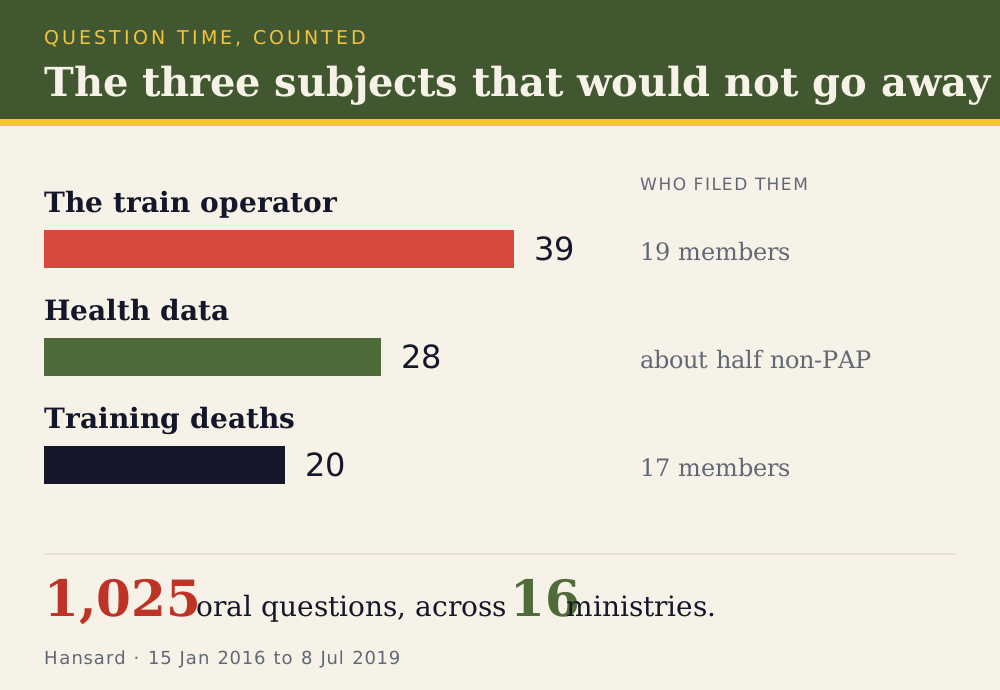
| Questions on the train operator | 39 | from 19 members |
| Questions on health data | 28 | about half from non-PAP members |
| Questions on training deaths | 20 | from 17 members |
15 Jan 2016 — 8 Jul 2019
Er Dr Lee Bee Wah is the MP most Singaporeans could name from a Question Time clip — sanitary pads, ungrateful children, Ah Gong’s savings. She is also, on the raw count, the second most prolific questioner in the 13th Parliament. Between 15 January 2016 and 8 July 2019 the Nee Soon GRC member filed 57 oral questions, 18 of them aimed at the Ministry of Transport.
She is not first. That is Leon Perera, with 62, including 12 for the Ministry of Trade and Industry. Dennis Tan follows on 49.
How the count was made
The figures here come from Hansard, the official verbatim record, from January 2016 when the 13th Parliament opened. The set is 1,025 oral questions across 16 ministries — questions that received a spoken answer in the House. Non-oral questions, which are answered in writing, are excluded; they are a different instrument and a much larger pile.
Within each ministry the questions were sorted by subject, so that questions about university admissions sit separately from questions about school meal subsidies even though both were put to the Ministry of Education.
What Question Time is
Ninety minutes, at the start of a sitting. An MP may file up to three questions, seven days before the House sits. The minister answers, and is then open to supplementary questions from anyone present — which is the part that cannot be rehearsed, and the reason Question Time tells you something a written answer never will.
Most questions filed
| MP | Constituency | Oral questions | Largest single target | To that ministry |
|---|---|---|---|---|
| Leon Perera | NCMP | 62 | Trade and Industry | 12 |
| Er Dr Lee Bee Wah | Nee Soon GRC | 57 | Transport | 18 |
| Dennis Tan | NCMP | 49 | Transport | — |
| Murali Pillai | Bukit Batok | — | Transport | — |
| Ang Wei Neng | Jurong GRC | — | Health | — |
| Cheng Li Hui | Tampines GRC | — | Transport | — |
Members shown with a dash are quoted later in this piece; their totals are not among the top three.
The three subjects that dominated
The train operator — 39 questions, 19 MPs. No single subject drew more. About 40 per cent of those questions came from opposition members and Non-Constituency MPs. The volume is not surprising given the run of high-profile breakdowns, the worst of which came in October 2017 when a flooded stretch of tunnel on the North-South Line — the main artery between the heartlands and the city — put up to 13 stations out of service across a weekend.
The questions moved quickly from the incidents themselves to the management. On 7 November 2017 Bukit Batok MP Murali Pillai pressed the Land Transport Authority’s dual position, asking how it balances its role as the regulator deciding whether an operator should be penalised against its other responsibilities.
It also produced the exchange that followed the minister around afterwards. Pressed by Tampines GRC MP Cheng Li Hui, Transport Minister Khaw Boon Wan said that the then-SMRT chief executive Desmond Kuek had “not been parachuted in” and had “volunteered for the job”. The remark was meant as a defence. It landed badly with commuters who were, at that point, blaming the same management for the breakdowns.
Health data — 28 questions. Half came from non-PAP members. Around 60 per cent concerned two incidents: the HIV Registry leak and the SingHealth breach. Personal information belonging to 14,200 individuals was leaked by Mikhy Farrera Brochez, an American. The questions that followed were less about the incidents than about the safeguards — Jurong GRC MP Ang Wei Neng asked when the last audit, internal or external, had been conducted on the databases holding that information.
Training deaths — 20 questions, 17 MPs. National Service makes every training death a national matter. Four in eighteen months guaranteed sustained questioning. After serviceman Aloysius Pang was killed during an overseas exercise in New Zealand, 17 MPs filed 20 oral questions on the incident. Defence Minister Ng Eng Hen answered them with a ministerial statement on 11 February 2019 — the same sitting at which they were asked.
What the distribution shows
Three ministries account for a visible share of the total on their own, and all three are ministries whose failures are felt physically rather than read about: a commute that does not work, a health record that leaks, a son who does not come home.
That is not an accident of the counting. Question Time responds to what constituents raise, and what constituents raise is what has happened to them. Ministries whose work is diffuse — policy that acts slowly, or acts on someone else — attract fewer questions regardless of how consequential they are.
The corollary is worth stating plainly: a low question count is not evidence that a ministry is performing well. It is evidence that its failures are less immediate.
Who does the asking
The assumption is usually that Question Time is an opposition instrument. The numbers do not behave that way.
The most prolific questioner in the term was a Non-Constituency MP, but the second was a government backbencher, and government backbenchers appear throughout the list. Backbenchers from the governing party question their own ministers regularly, and on the subjects above they did so in numbers.
What separates the two groups is not volume but persistence on a single subject. Opposition members returned to the same ministry sitting after sitting; government backbenchers spread their questions more widely. Both patterns are visible in the ministry column of the table above.
What a high count does and does not mean
A member who files many questions is using the instrument available to them. It does not follow that they are more effective, and the count says nothing about what the questions achieved.
An MP may file one question that changes a policy and fifty that do not. The record shows the fifty and the one identically. What the count does establish is who is doing the work of asking — which is a lower bar than effectiveness, but a real one, and the only one the record supports.
It also establishes the reverse. A member with a low count over three and a half years has chosen a different route: written questions, committee work, or constituency casework that never reaches the floor. Those are legitimate, and invisible here.
Why the supplementary is the part that matters
Everything above counts prepared exchanges. The prepared answer is written by officials who knew the question seven days in advance; it will be accurate, narrow, and responsive to exactly what was asked.
The supplementary is not. Any member present may ask one, on the spot, in response to what the minister has just said. There is no notice and no opportunity to research. That is where the Khaw Boon Wan remark came from, and it is where the state of preparedness of an office-holder becomes visible to everyone in the chamber at once.
Question Time is one of the few tools Parliament has for keeping a government on its toes without notice. Its value is not in the prepared answer — that could have been filed in writing — but in the follow-up.
The ballot, and why order decides depth
Questions are not taken in the order they were filed. They are drawn by ballot, and the ninety minutes end whether or not the list has been exhausted.
That has a consequence the counts above cannot show. A question drawn early can attract five or six supplementaries and occupy fifteen minutes; the same question drawn late may be reached in the last three minutes, answered, and left. A question not reached at all receives a written answer instead — the same words, with the follow-up removed.
So two members filing the same number of questions can have had very different sittings, and neither the total nor the ministry column reflects it. Depth is allocated by a draw.
What happens to a subject over time
The three dominant subjects behaved differently once the questions started, and the difference is instructive.
Transport questions ran for the length of the term. Each new incident restarted the cycle, and because the underlying problem was physical and recurring, no answer could close the subject. Volume stayed high because the facts kept changing.
The health-data questions clustered tightly around two incidents and then stopped. Once the safeguards had been described and the audits accounted for, there was nothing further to ask that a written question could not handle.
The training-death questions did something else again: seventeen members filed twenty questions for a single sitting, and the ministry pre-empted the exchange with a statement delivered the same day. That is the pattern for an incident serious enough that questions are certain — the ministry chooses to set out its position first rather than be assembled into one by supplementaries.
Three shapes, three subjects: a subject that will not close, a subject that closes once answered, and a subject answered before it was asked.
Parliamentary questions in writing: the larger pile
Everything above counts oral parliamentary questions. The written pile is larger, and leaving it out changes what the totals mean.
Parliamentary questions come in two forms and the choice between them is tactical. Oral parliamentary questions are answered aloud, consume floor time and open the door to supplementaries. Written parliamentary questions are answered on paper, do not consume floor time and cannot be followed up.
A member who wants a number files written parliamentary questions. A member who wants a minister on their feet files oral ones, and accepts that the ballot may leave the question unreached.
A non-oral question receives a written answer published in the record. It does not consume floor time, cannot be followed up in the chamber, and is not subject to the ballot. For extracting a figure — how many, since when, at what cost — it is the better instrument, and members who want data rather than a confrontation use it heavily.
The consequence for any ranking is direct. A member who files few oral questions may be filing many written ones, and a count of oral questions alone will describe them as inactive. The two instruments answer different purposes, and adding them together would be worse than reporting one, because it would average a confrontation and a data request into a single meaningless number.
What a ministry does with a question
The seven-day notice period is the part of the process least visible from outside, and it explains why prepared answers read the way they do.
A filed question goes to the ministry, which researches it, drafts a reply, clears it internally and returns it to the minister. The reply that results is accurate and narrow, because it was written by people who knew precisely what was asked and had a week to decide what to say.
That is not evasion; it is what a week of preparation produces. It is also why the supplementary matters so much, and why an experienced member files a question whose obvious follow-up is the question they actually wanted answered.
Where these figures come from
Every figure above is taken from Hansard, the official verbatim record of proceedings published by the Parliament of Singapore, covering sittings between 15 January 2016 and 8 July 2019. The set counts oral questions only. The exchanges quoted — Murali Pillai on 7 November 2017, Khaw Boon Wan replying to Cheng Li Hui, Ang Wei Neng on database audits, and Ng Eng Hen’s ministerial statement of 11 February 2019 — appear in the record for those sittings.
“Oral questions receive a spoken answer and allow an unrehearsed supplementary. Non-oral questions receive a written answer and cannot be pressed.
FAQOn this page
How many questions can an MP file?
Up to three oral questions per sitting, filed seven days in advance.
What is the difference between an oral and a non-oral question?
An oral question receives a spoken answer in the House and can be followed by supplementary questions. A non-oral question receives a written answer and cannot be pressed.
Where do these figures come from?
Hansard, the official verbatim record of proceedings, published by the Parliament of Singapore, covering 15 January 2016 to 8 July 2019.
Does a high count mean a more effective member?
Not by itself. A question is an instrument, and the supplementary that follows it is where the scrutiny is. The count measures activity, not outcome.