01
Adjournment motion
A short debate at the end of a sitting on a subject a member has raised. One of the few ways a backbencher can put a matter on the floor without a minister choosing to.
Reference · Singapore parliamentary terms
The terms that appear across these notes, defined once. Where a term has a specific meaning in Singapore that differs from its use elsewhere, the entry says so.
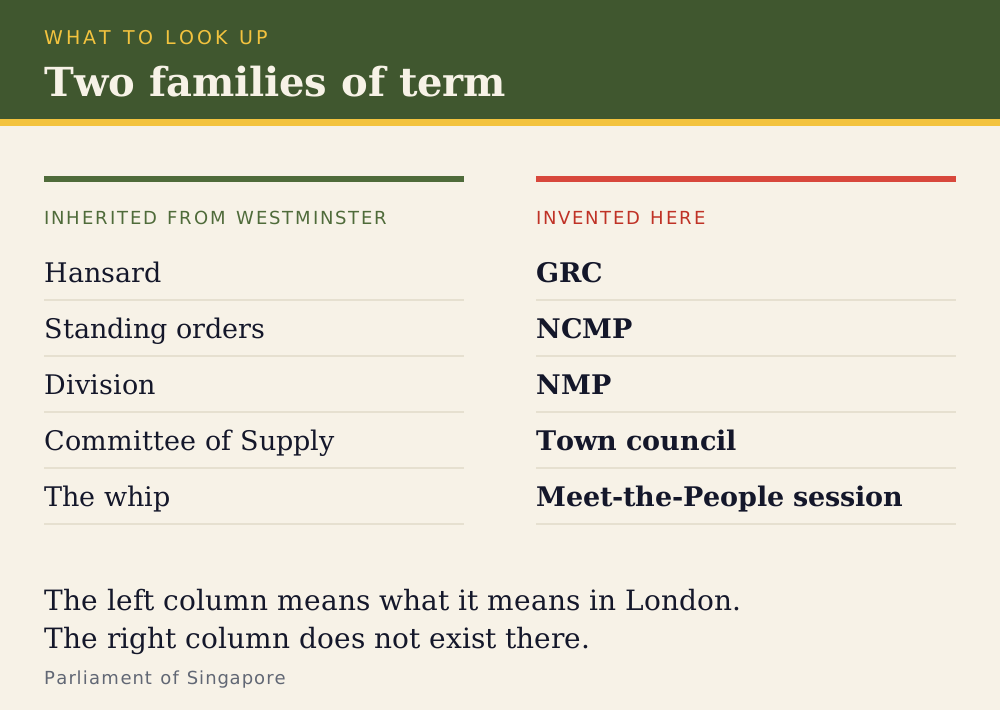
Most Singapore parliamentary terms are inherited from Westminster and mean what they mean anywhere else. Hansard is Hansard here as it is in London. The ones worth looking up are the local inventions, and the two most frequently confused are the first questions anybody asks: what a GRC is, and what an NCMP is.
The short answers: what a GRC is, is a constituency contested by a team rather than an individual. What an NCMP is, is a defeated opposition candidate given a seat because the opposition fell below a statutory floor. Neither has an equivalent elsewhere, which is why the rest of these Singapore parliamentary terms are easier to follow once those two are settled.
Everything defined below can be checked against Hansard, which is the record these Singapore parliamentary terms are used in. Where a term names a document, the entry says which body publishes it.
01 26 terms
A short debate at the end of a sitting on a subject a member has raised. One of the few ways a backbencher can put a matter on the floor without a minister choosing to.
A member who holds no ministerial office. In Singapore, government backbenchers file a substantial share of parliamentary questions.
In a cadre party, a member selected from within the party who is entitled to elect its central executive committee. The cadre roll is not published.
The stage of the Budget process where each ministry’s estimates are debated in turn. Where the detail of the year’s spending is actually examined.
A symbolic reduction to a ministry’s budget, moved so that a member can make a speech on that ministry’s policy. Almost always withdrawn after the minister replies.
A recorded vote, where each member’s position is registered individually. Most questions are resolved on the voices without one.
The Electoral Boundaries Review Committee. Convened by the Prime Minister, it decides the constituencies for a coming election and publishes no reasons.
The term used in boundaries reports for what is elsewhere called a constituency.
A Singapore citizen aged 21 or over on the electoral register. Boundaries are drawn by elector counts, not by population.
Group Representation Constituency. Contested by a team of three to five candidates, at least one from a minority community. A voter elects the whole team with one mark.
The official verbatim record of parliamentary proceedings, published by the Parliament of Singapore and searchable by member, ministry and sitting.
Telling members of a party that they may vote as they choose on a question. Rare, announced, and a signal in itself.
Non-Constituency Member of Parliament. A defeated opposition candidate offered a seat because the opposition fell below the statutory minimum. Since 2016 they vote on everything.
Nominated Member of Parliament. Appointed on the recommendation of a select committee, expected to be non-partisan, and distinct from an NCMP in every respect except being unelected.
A question answered in writing. It does not consume floor time and cannot be followed up with a supplementary.
The document setting out the business a sitting will take, in order.
A question answered aloud in the chamber, open to supplementary questions. Up to three per member per sitting, filed seven days ahead.
The Protection from Online Falsehoods and Manipulation Act. Provides for correction directions, targeted correction directions and the designation of Declared Online Locations.
Legislation introduced by a member who is not a minister. Rare in Singapore.
The ninety minutes at the start of a sitting given to oral questions. The supplementary, not the prepared answer, is where the scrutiny is.
Single Member Constituency. Returns one member. At least a quarter of all seats must be SMCs.
The rules governing how the House conducts itself, including what makes a question admissible.
The unscripted follow-up a member may ask after a minister has answered. The part that cannot be prepared for.
The body managing common property in a constituency — lifts, corridors, refuse, conservancy charges. Run by the constituency’s elected MPs.
A constituency uncontested at nomination because no opposing party filed a complete, certified slate before the deadline.
Both an office — the member managing a party’s members in the House — and the instruction telling them how to vote.