Elections · boundaries-report-what
The electoral boundaries report: the committee, the electors, the map
The release of a boundaries report is read as the starting gun for an election. What it actually contains is a list of electoral divisions, and the differences from the last list are where the politics sits.
Published
Published 13 Mar 2020
The surprise was the timing rather than the contents. The Electoral Boundaries Review Committee report was released, and with it the map that the coming general election will be fought on.
A boundaries report is a plain document. It lists electoral divisions, the streets and blocks each contains, and the number of electors in each. It gives no reasons. Everything that makes it consequential is in the comparison with the previous list, and that comparison has to be made by hand.
What actually changes
Three kinds of change appear, and they differ in how much they matter.
Lines move. An area transfers from one division to another, taking its electors with it. Where the area has a known voting pattern, the effect on both the origin and the destination can be estimated before campaigning starts.
Divisions appear and vanish. A new single-member constituency carved out of a GRC creates a contest that did not exist. A GRC dissolved and distributed among its neighbours removes the seat an incumbent team held.
Type and size change. A four-member GRC becoming a five-member GRC raises the number of candidates an opposing party must find. A single seat absorbed into a GRC removes one of the few contests a small party can realistically enter.
The third category is the one most often underweighted, because it does not look like a change on a map. It changes the arithmetic of entry.
Why the third category decides who can stand
A Group Representation Constituency is contested by a complete slate. A party that has three credible candidates in an area cannot contest a five-member GRC at all — not partially, not with a reduced team. It does not appear on the ballot there.
So when a report converts a three-member GRC into a five-member one, it does not make the contest harder for a small party. It removes the possibility of the contest. Nothing in the report says that, and the report is not wrong to omit it; the arithmetic simply follows from a different Act.
That is why walkovers recur in Singaporean elections. A constituency goes uncontested when no opposing party can assemble a complete, certified slate before nominations close — not necessarily because nobody wanted to stand.
How electoral boundaries are drawn: the committee, and the criticism
How electoral boundaries are drawn in Singapore is a short procedure with a long shadow, and the body that does it exists only for the duration.
The EBRC is not a standing body. It is convened by the Prime Minister, who sets its terms of reference, and it ceases to exist when it reports. Its members are senior civil servants: the Secretary to the Prime Minister’s Office as chair, with the heads of the Housing and Development Board, the Elections Department, the Singapore Land Authority, and the Chief Statistician.
So how electoral boundaries are drawn depends on who is in the room, and the room is made of the offices that hold the underlying data rather than of the parties that will contest the result.
That composition follows the task. Deciding where a boundary falls requires knowing where people live, how many there are and how the estates are laid out, and those are the offices that hold that information.
The objection is procedural rather than substantive, and it has three parts: the committee is convened by the head of the government whose party contests the election; it holds no hearings and publishes no reasons; and its recommendations have always been adopted. Together those mean the process cannot be audited from outside, whatever the merits of any individual decision.
The response made in Parliament has been that the members are career civil servants rather than politicians, that the terms of reference are published, and that population change explains the substantive movements. Both positions have been stated repeatedly and neither has moved the other.
Electors, not residents
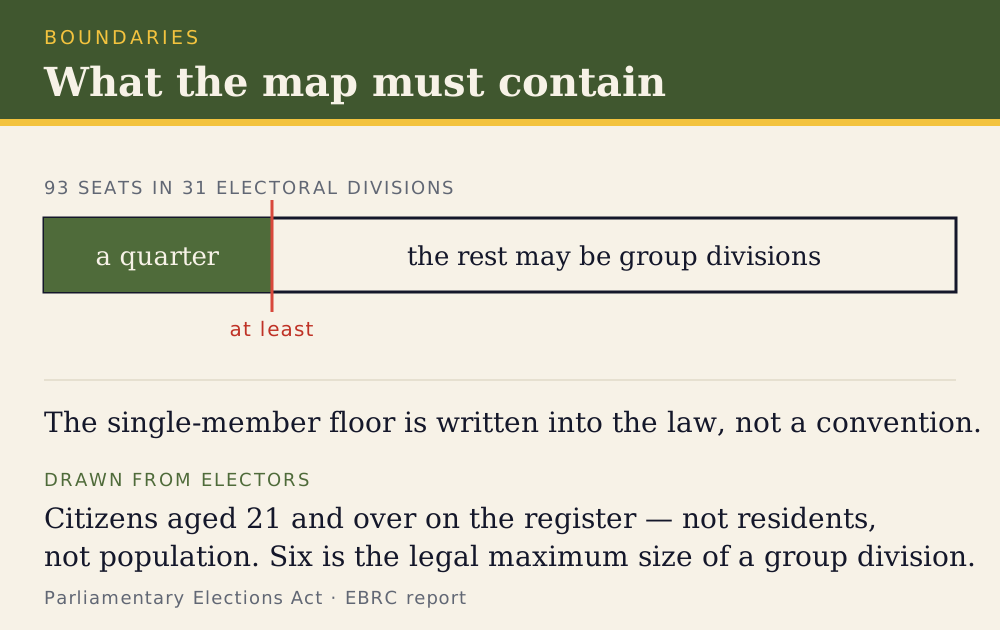
One detail changes how the report should be read. The committee works from the number of electors — Singapore citizens aged 21 and over who are on the register — not from population.
A division with many children, permanent residents or non-resident workers can have a modest electorate. An older area with a smaller apparent population can have a large one. So the elector counts in the report will not track population figures from any other source, and comparing a division’s size between two reports means comparing electors in both.
Reading the gap
The report’s publication is the last piece of public machinery that must be in place before an election can be called, because a dissolution cannot sensibly happen before the constituencies are known.
That is why its appearance is read as a signal. What it does not signal is timing: the interval between publication and dissolution has been as short as weeks and as long as months, and nothing requires it to be either.
For parties, the interval is the only window in which to reorganise around a map they did not know in advance. A party with branch structures across the island absorbs a redrawn map in weeks. A party with a handful of organised wards may find the ward it had been working in no longer exists in the form it was working on.
What the report cannot tell you
It cannot tell you why any line moved. It records the new map, not the difference from the old one and not the reasoning behind it.
It cannot tell you what the committee considered and rejected, because submissions are not published and there are no hearings.
And it cannot tell you when the election will be. The report is a precondition, not an announcement.
What it can tell you — precisely, and before anyone has been nominated — is which contests exist, how many candidates each requires, and how many electors will decide them. For a party working out where it can afford to stand, that is most of what matters.
How to read a report against the last one
The comparison is manual and the report does not help with it, so the method matters.
Start with the list of division names. Names that disappear and names that appear are the fastest signal, and they are not always what they seem: a division can keep its name while losing half its electors to a neighbour, and a renamed division may be substantially the same place.
Then compare elector counts for divisions that exist in both reports. A division whose electorate has moved sharply has either absorbed an area or lost one, and the direction tells you where to look next.
Finally compare type and size. This is the column that changes what a contest requires, and it is the one most easily skimmed past because it is expressed as a number of members rather than as a description of anything.
Three passes, two documents, no interpretation required. Everything beyond that is inference.
The quarter rule
One statutory constraint is worth stating because it bounds how far the map can go in one direction.
At least a quarter of all seats must be single-member constituencies. That is a floor written into the Parliamentary Elections Act, and it means the map cannot be composed entirely of large teams however the committee weighs its other considerations.
The floor is a real constraint on the arithmetic of entry described above: single seats are where a party with two or three candidates can actually stand, and their minimum number is fixed rather than discretionary. The number of single seats has risen in recent reports, alongside a shift toward smaller GRCs.
What the timing does not prove
The interval between a report and a dissolution has varied widely, and reading a short interval as evidence of intent is a step the documents do not support.
A report is a precondition. The decision to dissolve is separate, rests with the Prime Minister, and is subject to considerations — including, in 2020, a pandemic — that have nothing to do with boundaries.
What the report does establish is that the option now exists. Before it, an election could not sensibly be called; after it, one can be called at any time. That is the whole of what its publication signals, and it is why the signal is read so closely despite saying nothing about dates.
Why nobody proposes an alternative
The obvious reform — a permanent, independent boundaries commission with published reasoning and a right of submission — is not a novel idea, and versions of it operate in other jurisdictions that inherited the same parliamentary structures.
It has been raised in Parliament and has not advanced. The arguments made against it are that the existing committee is staffed by career civil servants rather than politicians; that its terms of reference are public; and that no specific boundary decision has been shown to be indefensible on the merits.
Each of those answers a different objection from the one usually made. The complaint is not that a particular line is wrong but that the process cannot be checked, and a process cannot be shown to be sound by pointing out that no one has proven it unsound. That asymmetry is why the argument recurs after every report and resolves after none of them.
What would settle it is publication: submissions received, options considered, reasons given. Nothing requires that, and nothing in the current arrangement produces pressure toward it.
Where to check this
The composition of each electoral division, and the number of electors in each, is in the report of the Electoral Boundaries Review Committee for that election, published by the Elections Department. The statutory limits on GRC size and the minimum number of single-member constituencies are in the Parliamentary Elections Act. Parliamentary exchanges about when the committee was convened and about its terms of reference are in Hansard, the official verbatim record of proceedings published by the Parliament of Singapore.
FAQOn this page
Who appoints the committee?
The Prime Minister convenes it and sets its terms of reference. It is chaired by the Secretary to the Prime Minister's Office and staffed by senior civil servants.
Does Parliament vote on the boundaries?
No. The recommendations are accepted by the government and given legal effect by order.
How soon after a report is an election held?
There is no fixed interval. The gap between publication and dissolution has been weeks in some cases and months in others.
What happens to a ward that disappears?
Its electors are absorbed into neighbouring divisions. Comparing that area across two elections means reading both boundaries reports, not the results alone.