The system · Item 04
How Question Time works, and why the supplementary matters most
Ninety minutes at the start of a sitting. MPs file up to three questions seven days ahead; ministers answer and can then be pressed by anyone in the House. It is the main tool Parliament has for putting an office-holder on the spot without warning.
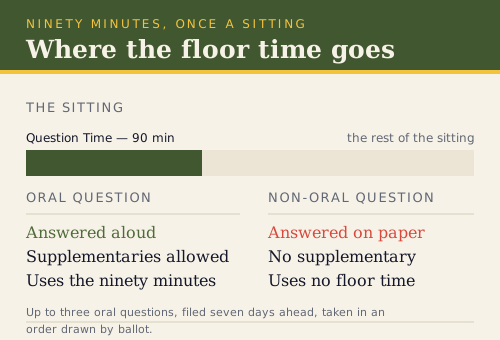
Question Time is the first business of a parliamentary sitting and runs for ninety minutes. Members put questions to ministers; ministers answer. It is the most regular, most predictable mechanism by which the executive has to account for itself in public, and the part of a sitting most likely to produce a clip that outlives the day.
The procedure is unremarkable on paper. What makes it work is one feature that cannot be prepared for, described at the end of this page.
The mechanics
Filing. A member may file up to three oral questions for a given sitting, and must do so seven days before the House sits. The notice period is not a formality: it is what allows a ministry to research an answer, and it is also what tells the ministry exactly what is coming.
Order. Questions are taken in an order drawn by ballot, not in the order filed. A question far down the order paper may not be reached within the ninety minutes; when that happens it does not disappear, but receives a written answer instead.
The answer. The minister — or a minister of state or senior minister of state answering on the ministry’s behalf — delivers a prepared reply. This is the part that has been researched for a week, and it is usually the least informative part of the exchange.
The supplementary. After the prepared answer, members may ask follow-up questions. This is the heart of the thing, and it is covered below.
Oral and non-oral questions
The distinction matters more than the names suggest.
An oral question is answered aloud in the chamber and is open to supplementaries. It occupies floor time, and floor time is scarce.
A non-oral question — often called a written question — receives a written answer published in the record. It is not read out, it cannot be followed up on the floor, and it does not consume any of the ninety minutes.
Written questions are far more numerous and are the workhorse of parliamentary scrutiny: they are how a member extracts a figure, a date, a count or a policy detail from a ministry. But they produce a document, not a confrontation. A minister answering in writing has unlimited time to phrase the reply and will never be interrupted.
This is why counts of “questions asked” can mislead if the two categories are added together. Three and a half years of the 13th Parliament produced 1,025 oral questions across 16 ministries. The written total over the same period was substantially larger.
What a question may and may not be
Questions are subject to rules of admissibility enforced by the Speaker. A question must seek information or press for action; it may not be an argument in disguise, may not contain inference or imputation, may not ask for an opinion on a hypothetical, and may not relate to a matter currently before the courts.
Members and ministries both work at the edges of these rules. A question framed as a request for a figure — how many, since when, at what cost — is admissible in a way that the same point framed as an accusation would not be. Experienced members ask for numbers precisely because numbers are admissible and because the answer, once given, is on the record and can be built on next time.
Where the pressure actually is
The prepared answer is written by officials who know the question. It will be accurate, narrow, and responsive to exactly what was asked and nothing more.
The supplementary is different. Any member present may ask one, on the spot, in response to what the minister has just said. There is no notice, no ballot, and no opportunity to research. A minister facing a supplementary is answering from their own knowledge of their own portfolio, in front of the chamber, without a script.
Everything that makes Question Time worth watching happens in that gap. The state of preparedness of an office-holder is visible; so is the point at which a line of questioning has found something. It is also where remarks get made that a prepared answer would never have contained — a minister defending a subordinate, or characterising a decision, in words chosen in the moment.
That is the accountability mechanism. Not the question, and not the answer: the follow-up.
Who asks
Question Time is open to every member, and members of the governing party use it as much as opposition members do. Backbenchers from the governing side question their own ministers regularly, and some of the highest individual question counts in recent Parliaments belong to government backbenchers rather than opposition members.
This is worth stating because the assumption runs the other way. In the 13th Parliament the most prolific questioner filed 62 oral questions; the second-placed member, with 57, sat on the government benches. Question Time is not structured as an opposition instrument, and the numbers do not behave as though it were.
Non-Constituency MPs may file questions on the same terms as elected members. Nominated Members may too, and often do so in their own fields of expertise.
What happens when the answer is unsatisfactory
Question Time has no enforcement. A minister who gives a narrow answer cannot be compelled to give a wider one, and the ninety minutes end whether or not anything has been resolved.
The remedies are elsewhere: refile the question in a sharper form at the next sitting; convert it into a written question that demands a specific figure; raise it during the Committee of Supply debates, where a member may move a symbolic reduction to a ministry’s budget in order to secure time to speak on that ministry’s policy; or move an adjournment motion.
A pattern of questions across sittings is also a tool in itself. A subject that draws sustained questioning from many members over months becomes difficult to treat as settled, whatever any individual answer said — and the record of who asked, when, and how often is public.
Ministerial statements
A minister may also come to the House and make a statement on a matter, rather than waiting to be asked. This usually happens when an incident is significant enough that questions are certain, and the ministry prefers to set out its position first.
Members may then question the statement. In practice this compresses what would have been several sittings of Question Time into one exchange, and it is the mechanism used after serious incidents — including, in February 2019, a ministerial statement delivered in the same sitting at which twenty oral questions on a single training death had been filed by seventeen members.
How the ninety minutes get used up
The clock is the constraint that shapes everything else, and it is not generous.
Ninety minutes divided among the questions that reach the floor leaves a few minutes each. A single question that attracts sustained supplementaries from several members can consume ten or fifteen minutes on its own, which pushes everything below it further down and makes it likelier that later questions will fall off the order and be answered in writing instead.
This produces a tactical layer that is invisible unless you know it is there. A member who wants a subject aired at length benefits from being drawn early in the ballot. A member whose question is drawn late may get a written answer and no supplementaries at all — the same question, with the accountability mechanism removed. Neither outcome is anyone’s decision; the ballot is a ballot.
It also means the Speaker’s management of the session matters. Deciding how many supplementaries to allow on a question, and when to move on, determines how deep any single line of questioning can go. That judgement is exercised in real time and is not reviewable.
What Question Time cannot reach
Three categories sit outside it, and they are worth knowing because they are where questions sometimes need to go instead.
Matters before the courts. A question relating to proceedings that are live before a court is inadmissible. This is the sub judice rule, and it applies regardless of how much public interest attaches to the case.
Operational detail a ministry declines to give. Security, defence deployments and certain law enforcement matters are routinely answered at a level of generality that the question did not ask for. There is no mechanism to compel more.
Anything that is not a ministry’s responsibility. Questions must be directed to a minister on a matter for which that minister is answerable. Statutory boards, town councils and private entities are reachable only through the ministry that oversees them, and only to the extent that oversight extends.
The last category is the one that produces the most frustration in practice, because the entity a resident is actually dealing with is frequently not the entity a minister answers for.
A town council is the standard illustration. It is run by the elected members of its constituency rather than by a ministry, so a question about a town council’s maintenance decision is not a question any minister is answerable for. The ministry that oversees town councils can be asked about the framework, the audit requirements and the reporting obligations — but not about the decision itself. Residents rarely draw that distinction, and the member taking the question at a Meet-the-People session often has to explain that the complaint and the available parliamentary instrument point at two different bodies.
Where to check this
The rules governing the admissibility of questions, the notice period, the ballot and the conduct of Question Time are in the Standing Orders of Parliament. Every question, every answer and every supplementary is recorded in Hansard, the official verbatim record of proceedings published by the Parliament of Singapore, which is searchable by member, by ministry and by sitting date.
FAQOn this page
How long does it last?
The first ninety minutes of a sitting, before other business.
How many questions can a member file?
Up to three oral questions per sitting, seven days in advance. A ballot decides the order in which they are reached.
What is a supplementary?
An unscripted follow-up any member present may put after the minister has answered. It is where the scrutiny actually happens, because it cannot be prepared for.
What is a written question for?
Extracting figures. It is answered on paper, consumes no floor time and admits no supplementary, so it is the better instrument for data and the worse one for pressure.