The system · Item 07
What is a Meet-the-People session, and why has the practice lasted?
Weekly, in every ward, for decades. Residents queue to put a problem to their MP in person — a debt, a housing appeal, a school placement. It is the most consistent point of contact between an MP and the people who elected them, and it has almost no equivalent elsewhere.
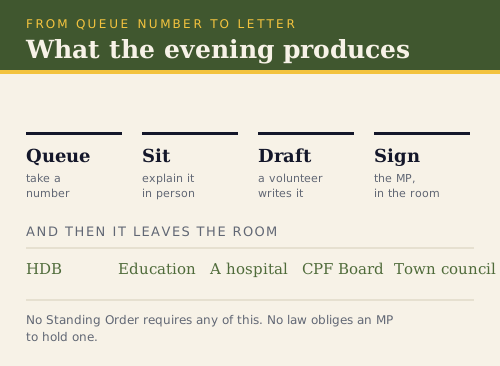
Once a week, in every constituency in Singapore, a Member of Parliament sits in a room — usually a void deck or a community centre — and residents queue to speak to them one at a time. The queue forms in the evening. The sessions often run past midnight.
This is the Meet-the-People session, universally shortened to MPS. It is not written into any statute, it is not required by the Standing Orders, and no law obliges any MP to hold one. It is nonetheless close to universal, has been for decades, and is the single most reliable point of contact between Singaporeans and the person who represents them.
What actually happens in the room
A resident takes a queue number and waits. When called, they sit down with the MP and explain a problem. The problems are overwhelmingly practical and overwhelmingly personal:
- an appeal against a housing allocation, or a request to be reassessed for a flat
- arrears — rent, conservancy charges, utilities — and a request for help with a payment plan
- a school placement for a child
- a medical bill beyond what the household can cover
- an immigration matter for a spouse
- a dispute with a neighbour, a town council or a government agency
- employment, after a dismissal or an injury
The MP listens, asks questions, and in most cases the outcome is a letter. A volunteer at an adjacent table drafts it while the resident waits, the MP signs it, and it goes to the relevant agency — HDB, the Ministry of Education, a hospital, the Central Provident Fund Board, a town council.
What the letter is and is not
The letter is not an instruction. An MP cannot direct HDB to allocate a flat or a hospital to waive a bill, and the agencies are not obliged to agree.
What the letter does is put a case in front of a named official with a named member of Parliament attached to it, and ask for it to be looked at again. It restates the facts, sets out why the standard outcome produces hardship in this instance, and requests reconsideration. Agencies reply, and the replies come back to the MP’s office, which follows up.
The mechanism is therefore appeal, not override. Its value lies in three things: it forces a second look at a decision made by rule; it translates a resident’s situation into the language and format the agency actually processes; and it attaches a degree of political visibility to the outcome.
That last point is the part that does the work, and nobody involved pretends otherwise.
Who else is in the room
An MPS is not run by the MP alone. A functioning session has:
Writers, who draft the appeal letters. This is the bulk of the volunteer labour, and it requires knowing which agency handles what and how an appeal to that agency should be framed.
Queue and intake volunteers, who register residents, take down the nature of the case and order the queue.
Case officers, who track what happened to each letter, chase agencies that have not replied, and tell residents the outcome.
For the governing party these volunteers largely come from the constituency branch. For an opposition MP they come from that party’s own volunteers. Either way the session is a standing organisation, not an evening’s work, and running one competently is a substantial ongoing commitment.
Why it persists
Several explanations are usually offered, and they are not mutually exclusive.
It works, narrowly. Appeals succeed often enough that queueing is rational for the resident. A system that processes large numbers of people by rule will produce hard cases, and this is the channel through which hard cases get reviewed.
It is an information channel upward. An MP who sits through a weekly queue for years accumulates a detailed, unfiltered picture of where policy is failing at the point of contact — which arrears are rising, which scheme is confusing people, which agency is slow. That information reaches Parliament, and questions filed at Question Time frequently originate in an MPS queue.
It is the relationship. Constituency work is how an MP is known to the people who elect them. An MP who is visible weekly is a different proposition at an election from one who is visible during a campaign.
The criticisms
Two are made consistently.
The first is that the system institutionalises the appeal as a route around policy. If a rule produces enough hard cases that a weekly queue is needed to handle them, the argument goes, the rule is the problem, and a functioning appeals channel reduces the pressure to fix it.
The second concerns the overlap between party and state. The volunteers are party volunteers, the venue is often a facility administered through structures connected to the governing party, and the letter that reaches the agency carries a party-affiliated MP’s name. Access to the mechanism is therefore mediated by party infrastructure, which is denser in some places than others.
Both criticisms are about the structure, not about the individual sessions, and neither has produced a proposal to abolish the practice.
What has changed, and what has not
Digital channels have been added — online appointment booking, e-appeals, some agencies accepting submissions directly — and the pandemic forced sessions online or into appointment slots for a period.
The queue came back. The recurring explanation from people who run sessions is that the cases which reach an MPS are disproportionately ones where the resident could not navigate the standard channel: language, literacy, complexity, or simply not knowing which agency is responsible. A web form does not solve any of those. What the resident needs is someone across a table who knows where the case should go and can put it there.
What it tells you about the job
The MPS explains a structural feature of Singaporean politics that is otherwise puzzling: why so much of what an MP does has nothing to do with legislation.
An MP’s week contains the sitting, the questions, the committees — and the queue, the letters, the follow-ups and the estate. For most MPs the second set takes more hours than the first. It also explains the practical weight of the distinction between a member with a constituency and a member without one: a Non-Constituency MP has the floor, the questions and the votes, but no queue, because there is no ward.
The letter, in detail
Because the appeal letter is the actual output of the session, its construction is worth setting out.
A competent letter does four things. It states the resident’s circumstances in the terms the receiving agency uses — household income, flat type, arrears amount, dates. It identifies the specific decision being appealed and when it was made. It sets out the ground for reconsideration, which is almost always that the standard criteria produce an outcome that does not fit this case. And it asks for a specific remedy, rather than for sympathy.
The last point separates letters that work from letters that do not. An agency can act on a request to reassess an income calculation, extend a payment period or review a placement. It cannot act on a request to help.
Volunteers who write these letters develop agency-specific knowledge that exists almost nowhere else — which office handles which appeal, what evidence is required, which phrasing triggers a review and which is filed. That expertise is the real asset of a long-running session, and it does not transfer when the volunteers change.
What happens to the reply
Replies come back to the MP’s office, not to the resident, which is why case tracking exists.
An agency may grant the appeal, grant it partly, refuse it with reasons, or ask for more information. Each of those requires a different follow-up, and the resident has to be told. Sessions that work well close the loop; sessions that do not leave residents queueing again to ask what happened.
A refusal is not necessarily the end. A refusal with reasons tells the MP’s office exactly which criterion the case failed, and a second appeal can address it directly. Repeat appeals on a single case are common, and the process can run for months.
Why the record matters
Individual cases are confidential, but their aggregate is not, and this is where an MPS connects back to the chamber.
An MP who has processed several hundred appeals against the same agency criterion has something harder than an anecdote: a pattern. That pattern is what turns into a parliamentary question with a number attached to it — how many appeals, over what period, with what outcomes. The question is admissible because it asks for a figure, and the figure exists because someone kept the case records.
The route from a void deck on a Tuesday night to a question at the start of a sitting is short and well travelled, and it is the clearest example in Singaporean politics of constituency work feeding directly into scrutiny of the executive.
Where to check this
Meet-the-People sessions are a convention rather than a statutory duty, so there is no Act that describes them. Session times and venues are published by each constituency. The parliamentary context — questions raised about appeal outcomes, agency response times and constituency casework — is in Hansard, the official verbatim record of proceedings published by the Parliament of Singapore. The appeal processes of individual agencies are published by those agencies.
FAQOn this page
Is an MP required to hold one?
No. Nothing in statute or the Standing Orders requires it. The practice is convention, and close to universal.
What does the MP actually produce?
Usually a letter asking the responsible agency to reconsider a decision. It obliges nobody; it puts the case in front of a named official with an MP's name attached.
Can anyone attend?
In practice the sessions serve the constituency's residents. Someone from another ward is generally directed to their own MP.
Why has the practice lasted?
Because it works often enough that the queue forms every week, and because it is the most direct appeal route most people have.